

Youth sports continue to grow at an incredible rate year after year. Instead of recommending that kids play multiple sports, we add more games to the schedule and make it mandatory to stick to one. More games during the year means more practices, more at bats, more innings pitched. On top of that, it’s getting ridiculously competitive at the youngest levels. The other day I saw a team had to pay to get someone to do a “scouting report” of their team at 10 years old. I’ll save my feelings on that for another post. What I aim to do with this post is share a couple ways that youth coaches can improve the way their team prepares for sport.
Throughout my time in professional sports, I’ve learned one very important rule. You have to spend time preparing to play. I am talking to the coaches that have their players roll out of bed and go right into playing games. I am talking to the coaches that have their players walk into a batting cage and take hacks 5 seconds later. Great organizations, great teams, great players prepare to play the game. A great coach I had the pleasure of working with once said, “you warm-up to hit, not hit to warm-up”. That quote stuck with me and I hope if you take anything from this post it is that.
Here are a few ways to organize your pre-game or pre-practice warm-up to get the most bang for your buck:
A) Start with general movements that take the players joints through the ranges of motion required in the sport:
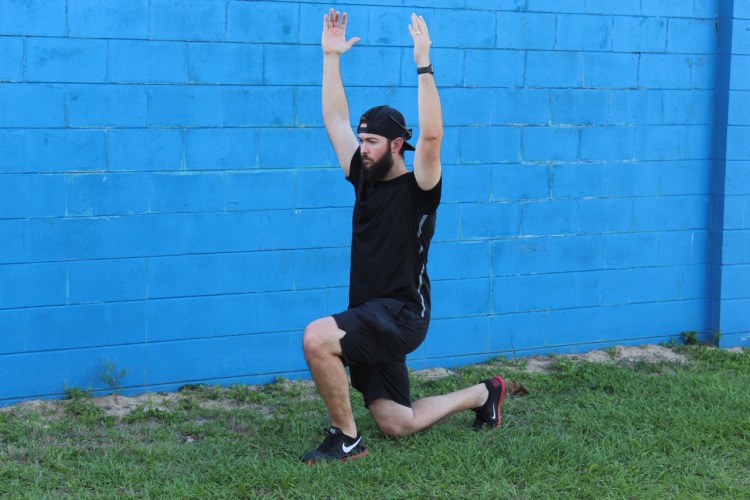
The prep drill shown above is a walking lunge with your arms overhead. A sport like baseball is mostly unilateral in nature with hitting, running, and throwing all requiring you to be in a split stance. By taking the hip and shoulder joint through full ranges of motion, you are preparing the player for more optimal working conditions. Now, when a player goes to throw or swing in practice, their body is more familiar with that position. It is amazing how much progress some of the young athletes I’ve trained can make in a short amount of time with a dynamic warm-up. Coordination is typically lacking in a youth athlete and this a great way of improving it. Practicing things like lunges/squats helps them become more balanced and stable as well as gain a little bit of strength in the process.
B) Improve athletic ability with a few plyometric based activities
Once your athletes have done some quality movement, it would be great to follow that up with something athletic and explosive. As a strength coach, I don’t want my athlete’s first run or jump to be in competition. We want to prepare the body so that the team is ready from the first whistle or pitch. So, follow part one with some skips, hops, jumps, and bounds. Be careful and put some thought into which drills you select based on the level you coach. For example, if I am working with a very young baseball player I need to start with slower movements and spend time teaching. This athlete may not know how to run, jump, land correctly yet so I need to build in very basic drills first. If I’m working with a professional athlete, we can select more complicated drills.
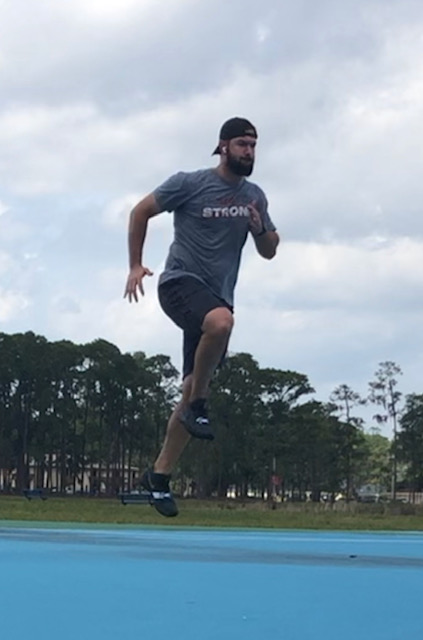
Shown to the right is a single leg plyometric skip drill that I use often in my own training. This is for more advanced athletes as it requires more balance and unilateral strength. When working on sprinting or jumping drills, you want to create as much force as possible in as short amount of time as possible. Speed kills in any sport and you need to dedicate time to practicing the technique. A warm-up is a great place to do that at any level.
I recommend at least 3-4 drills, 2-3 sets of 4-5 reps for each one. Be present as a coach and be sure to keep things basic until your athletes show they have mastered the drill.
C) Game speed or agility should be the final component
Now that you have gone through necessary ranges of motion performed some plyometric athletic drills I recommend you finish with some sport-specific game speed drills. Don’t confuse the plyometric drills from before with this. Those drills are intended to focus on technique while this section is more about locking it in for the actual competition. In Part B, you can practice where your arms need to be or where your foot makes contact with the ground. Part C is all about running at the speed you need to play the game. Don’t overthink this section, just have your athletes run 4-5 game speed sprints or possibly do 4-5 reps of a change of direction drill. Hopefully you will see a couple of the players applying the work from part B into their sprints. It’s all about preparing the body so that they are ready to run full speed in the first quarter or inning.
Take home message:
- Having a 10-15 minute warm-up pre-game and pre-practice is vital to the health and development of your team
- Organize your warm-up into three sections (Joint Prep, Plyometric, Game Speed)
- Make sure the coaching staff is present during this time. You can learn a lot about a player from watching them prepare
- Remind players that a warm-up is as much mental prep as it is physical
- Challenge your players in the warm-up so that they are ready for the demands of competition. Sprint/cut hard a few times at the end
- Warm-up to play, don’t play to warm-up
For more information on a dynamic warm-up, here is a link to a detailed video I did to provide any youth coach or team a guideline to follow:
Please leave comments below with any questions about this article. I have a few spots available for online coaching at the time of posting this and would be happy to do consulting work for a team looking to take a step up in what they offer.
 Peak Sports Performance